

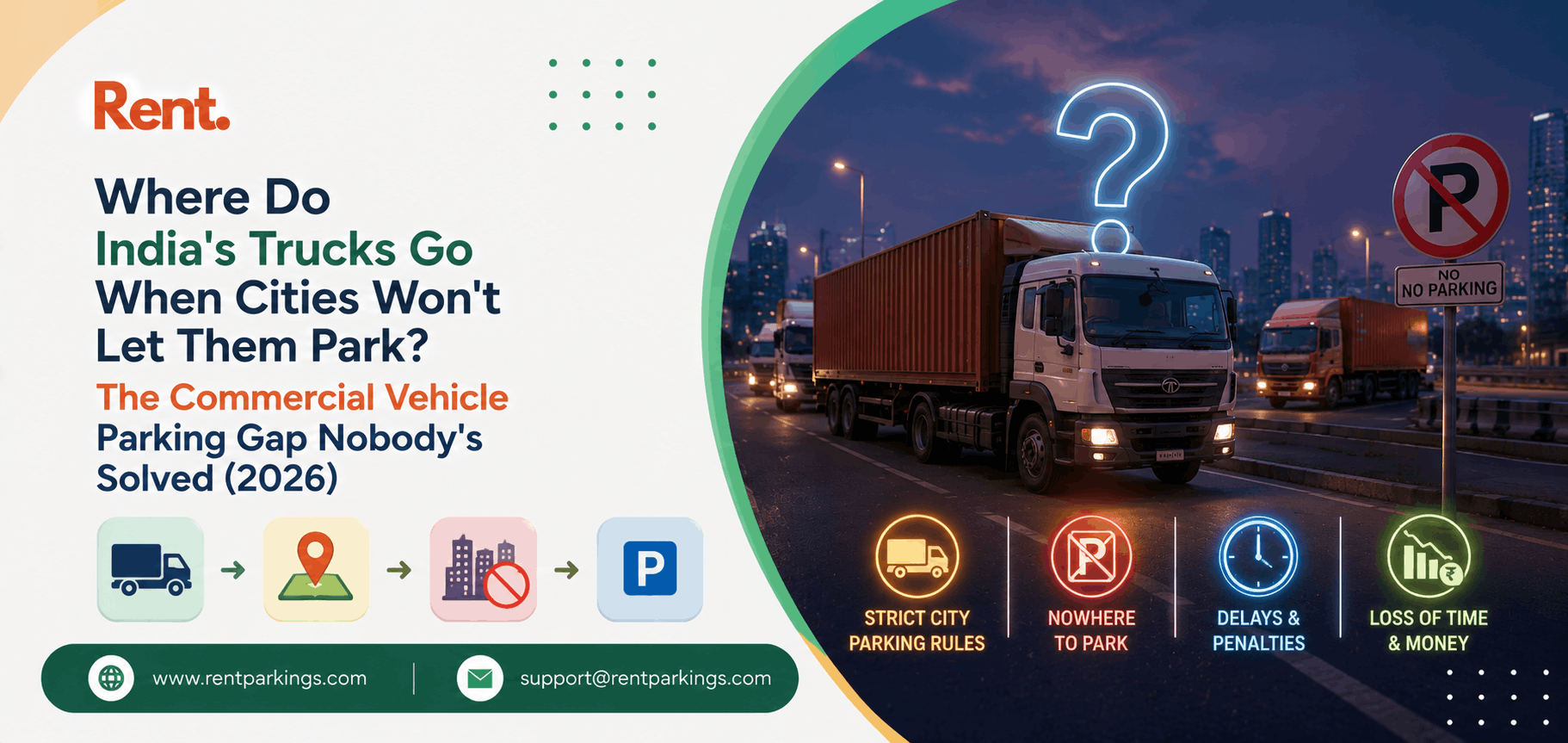
Where Do India's Trucks Go When Cities Won't Let Them Park? The Commercial Vehicle Parking Gap Nobody's Solved (2026)
Ask a truck driver in Bengaluru where he parks for the night, and he probably won't give you a clean answer. Somewhere off Attibele Road, maybe, if there's a gap in the shoulder. Behind a dhaba near Hosur Road, if the owner allows it that week. Or wherever the last traffic constable didn't chase him off. Ask the same question in Ghaziabad, Bhiwandi, or Sriperumbudur and you'll get a version of the same shrug.
That uncertainty isn't a minor operational headache. It's baked into how Indian cities regulate traffic. Every major metro restricts when heavy commercial vehicles can enter municipal limits, but very few of them specify where those vehicles are supposed to go once they're pushed out. The result is a parking gap that most residents never notice, because it plays out on the edges of the city, after dark, far from the neighbourhoods where people usually think about parking. Owners of land near highways and industrial belts who understand this gap are already earning steady monthly income from it — often through RentParkings, India's parking marketplace connecting idle land with people who genuinely need somewhere legitimate to park.
The Rule Nobody Explains Properly
Most Indian cities enforce time-window restrictions on heavy vehicles entering city limits. Delhi keeps trucks out of large parts of the city during daytime hours unless they're making a local delivery. Mumbai's municipal rules push commercial vehicles out of the island city and central business districts for most of the day. Bengaluru, Chennai, Pune and Hyderabad each run their own version of the same idea — heavy vehicles are welcome at night, tolerated at the edges, and actively discouraged from clogging arterial roads during peak hours.
The logic makes sense from a traffic-management standpoint. A loaded 32-foot container truck takes up the road space of several cars and slows everything around it. Keeping that traffic out during the day genuinely reduces congestion and road wear.
What the rule doesn't do is answer the obvious follow-up question. If a truck can't be in the city by day, and its delivery window doesn't open until early morning, where does the driver — and the vehicle, and often the cargo — spend the night in between?
So Where Do They Actually Go Right Now?
In practice, drivers improvise. Highway shoulders near toll plazas fill up after dusk. Vacant plots close to industrial estates get used informally, sometimes with a small cash payment to whoever's watching the land, sometimes without anyone's knowledge at all. Dhaba parking lots along national highways do double duty as informal truck stands, charging a flat rate that covers a meal, a charpai to sleep on, and a patch of ground for the vehicle.
None of this is secure in any real sense. Cargo theft from parked trucks is a recurring complaint among fleet operators and transport unions. Drivers sleeping in unlit, unguarded spots are exposed to accidents from passing traffic and, in some stretches, to opportunistic crime. Vehicles parked on road shoulders regularly get challaned for obstruction, adding cost and friction to journeys that are already running on thin margins.
It's the same underlying pattern this niche keeps surfacing: acute, visible demand for parking, and almost no organised supply built to meet it. The areas around major industrial corridors already rank among India's busiest parking hotspots, and heavy commercial traffic adds another layer of pressure that most local infrastructure was never designed to absorb.
A Warehousing Boom Is Quietly Making This Worse
Two forces are colliding here. The first is India's logistics and e-commerce expansion — the growth of large fulfilment centres and last-mile hubs around cities has pushed truck movement to levels the surrounding infrastructure wasn't built for. Corridors like Bhiwandi outside Mumbai, Manesar and Farukhnagar near Delhi NCR, Sriperumbudur and Oragadam outside Chennai, Chakan and Talegaon near Pune, and Sanand near Ahmedabad have all seen a sharp rise in warehousing activity over the past few years.
The second force is the GST-era e-way bill system, which removed most inter-state border checkpoints and, in theory, sped up trucking across the country. Vehicles now move faster between states — but city-entry restrictions inside each metro haven't changed to match. More trucks are arriving at city edges with nowhere organised to wait out the restricted hours.
Every one of those corridors has landowners sitting on plots that are either vacant, underused, or generating far less income than the demand around them would justify.
The Business Hiding in Plain Sight
For someone who owns a plot near a highway entry point, a toll road, or an industrial belt, this gap is essentially an asset sitting idle. A fenced, reasonably flat piece of land in the right location can be rented out as overnight parking for trucks, tempos, and other commercial vehicles — and the earning potential per square foot is often better than what the same land would fetch as passenger car parking.
This isn't a hypothetical comparison either. Plenty of owners in this niche keep asking a version of the same question — whether an idle plot is worth more than money sitting in a fixed deposit — and land positioned near a logistics corridor tends to answer that question fairly convincingly, the way we've laid out when comparing an idle parking asset against a fixed deposit for smaller residential spaces.
What Kind of Land Actually Works
- Reasonably flat, all-weather surface — gravel or compacted earth is acceptable; concrete or asphalt commands a premium
- Boundary fencing or a wall, even a basic one, to establish that the space is controlled and secure
- Enough turning radius for a loaded truck to enter, park, and exit without reversing onto a public road
- Proximity to a highway entry point, toll plaza, or industrial estate — ideally within a few kilometres
- Drainage that holds up during the monsoon, since waterlogged yards are unusable for weeks otherwise
What It Realistically Pays
Rates vary by city, security level, and whether the arrangement is a one-off nightly booking or a standing monthly contract with a transport company. As a rough sense of range: casual nightly parking for a single truck tends to fall somewhere between ₹150 and ₹400 depending on the city and facilities offered, while landowners who sign monthly contracts with fleet operators or transport associations — reserving a fixed number of bays — often see figures well above what individual nightly bookings would add up to, since operators pay a premium for guaranteed, reliable space. City-by-city pricing benchmarks for parking in general, which are a useful reference point even for commercial yards, are covered in our parking rental rates guide across Indian cities.
What Transport Companies Actually Look For
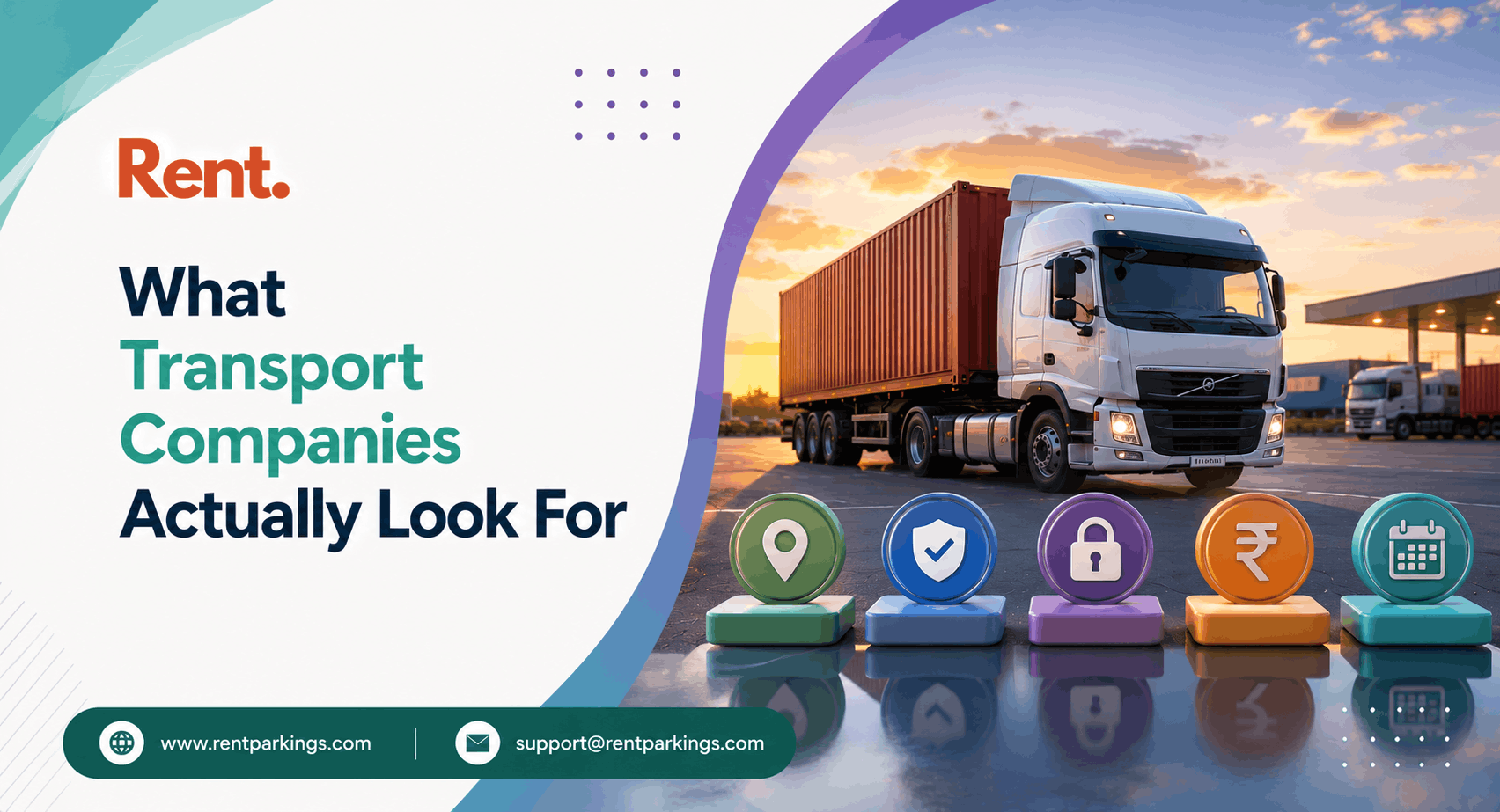
Fleet operators and transport unions aren't shopping for the cheapest patch of dirt. They're shopping for reliability. A yard with visible lighting, a watchman or basic CCTV, and a formal booking process tends to win repeat business over an informal arrangement, even if the informal option is marginally cheaper. Water availability for washing vehicles and a stretch of shade matter too, since drivers often rest in or near the vehicle during the day before a night shift.
The Legal Side Most Owners Skip — and Shouldn't
Renting land for commercial vehicle parking isn't complicated, but it does deserve more structure than a verbal handshake. A written agreement specifying duration, rate, and liability protects both sides. Verifying the vehicle operator's identity and documentation before granting regular access is a basic precaution, particularly for unattended overnight yards. Owners letting out larger plots for the first time often benefit from walking through the broader groundwork first — documentation, tax treatment of rental income, and what happens if something goes wrong. Our legal, tax, and safety guide to renting out parking space in India covers that groundwork in plain terms, and most of it applies whether you're letting out a car bay or a full commercial yard.
It's also worth avoiding any permanent construction on land zoned for agricultural or non-commercial use until you've confirmed what the local development authority permits. A fence and a gate are generally fine; a concrete structure without the right approvals can invite complications later.
Getting Started If You Own Land Near a Highway or Industrial Belt
The process doesn't need to be elaborate. Start by honestly assessing what the land offers today — surface condition, access road, and how close it sits to a corridor with real truck movement. Add whatever basic security is affordable, even if it's just fencing and a padlocked gate to begin with. Decide whether nightly bookings, monthly contracts, or a mix of both suits your situation better, since fleet operators generally prefer the certainty of a monthly arrangement while independent truckers book night to night.
From there, list the space with clear photos, exact dimensions, and an honest description of what's available on site. Owners who've gone through this before often say the earning side surprises them once demand meets a listing that's easy to find — something we've broken down in detail in our guide on how much you can actually earn renting out a parking space in India.
Frequently Asked Questions
Is it legal to rent out my land for truck or commercial vehicle parking in India?
Yes, renting private land for vehicle parking is generally permitted, provided the land isn't restricted for a use that conflicts with commercial letting. It's worth checking your local municipal or development authority rules if you plan to add permanent structures, but using open land for parking with basic fencing rarely requires special clearance.
How much can I earn renting land as a truck parking yard?
It depends heavily on location, security, and whether you're booking nightly or signing monthly contracts with transport companies. Nightly rates for a single vehicle commonly range from roughly ₹150 to ₹400, while monthly contracts covering multiple reserved bays typically add up to considerably more over the same period.
Do I need a special license to operate a truck parking yard?
In most cases, no specific parking license is required for open-land parking, though this can vary by state and municipality. If you plan to offer additional services like fuel, washing, or a dhaba alongside parking, those add-ons may carry their own local licensing requirements.
What size of land is suitable for commercial vehicle parking?
There's no fixed minimum, but a plot needs enough room for a loaded truck to manoeuvre, park, and exit without reversing onto a public road. Smaller plots can still work for two or three vehicles at a time; larger yards near major corridors can accommodate dozens.
How is truck parking different from car parking as a rental business?
Commercial vehicle parking usually earns more per square foot than passenger car parking in the same area, because demand is concentrated around specific corridors and operators value reliability enough to pay for it. It also tends to involve fewer, larger transactions — one fleet contract can replace dozens of individual car-parking bookings.
What security measures should I add before listing my land for truck parking?
Basic boundary fencing, a gate that can be locked, and adequate night lighting cover the essentials. A watchman or CCTV system adds a meaningful trust signal for fleet operators comparing your yard against informal alternatives, and often justifies a higher rate.
Can I rent my land to logistics companies on a monthly contract instead of nightly bookings?
Yes, and many landowners prefer this arrangement once demand is established, since it offers predictable income without managing individual bookings each night. Monthly contracts with transport companies or fleet operators are common in areas near warehousing hubs and industrial corridors.
Is demand for commercial vehicle parking seasonal in India?
There's some fluctuation tied to festival-season shipping volumes and monsoon-related disruptions, but overall demand tends to stay fairly steady compared to, say, event or tourist parking, since goods movement continues year-round regardless of season.
What are the risks of renting my land for commercial vehicle parking, and how do I protect myself?
The main risks are disputes over damage, unpaid dues, or unauthorised extended use of the space. A written agreement covering duration, rate, and liability, along with verifying the renter's identity and vehicle documentation, addresses most of these concerns before they become problems.
How does a platform like RentParkings help with commercial vehicle parking specifically?
It gives landowners a way to list larger plots with the specific details fleet operators and transport companies look for — dimensions, surface type, security features, and access — while giving operators a verified, searchable alternative to informal roadside parking. That visibility is usually the missing piece for owners who have suitable land but no way to reach the right renters.
Conclusion
The trucks aren't going anywhere. If anything, India's warehousing and e-commerce growth means more commercial vehicles will need somewhere legitimate to wait out city-entry restrictions every single night, not fewer. Right now, that need is being met mostly by improvisation — a dhaba's back lot here, an unlit highway shoulder there — which is precisely why organised, secure parking near highways and industrial belts stands out as an opportunity rather than a niche curiosity.
If you own land near a highway entry point, toll road, or industrial corridor that's sitting idle or underused, this is worth a serious look. List your parking space on RentParkings and start turning that plot into a dependable monthly income stream — set your own rates, choose hourly, daily, or monthly rentals, and reach verified drivers and fleet operators actively searching for exactly what you have to offer.
Share This post
Search
Recent Post
Parking Space vs. Renting Out a Room to...
05 Oct, 2026

Think Parking Rental Only Pays in Mumbai...
02 Oct, 2026
Your Mumbai Parking Space Is Worth More...
01 Oct, 2026

Hyderabad's Real Estate Boom Left One As...
30 Sep, 2026

What Your Parking Space in Chennai Could...
29 Sep, 2026
Your Plans Changed After Listing Your Pa...
28 Sep, 2026
Parking Space vs SIP: Which Idle Asset A...
25 Sep, 2026

What Your Parking Space in Pune Could Ac...
24 Sep, 2026