

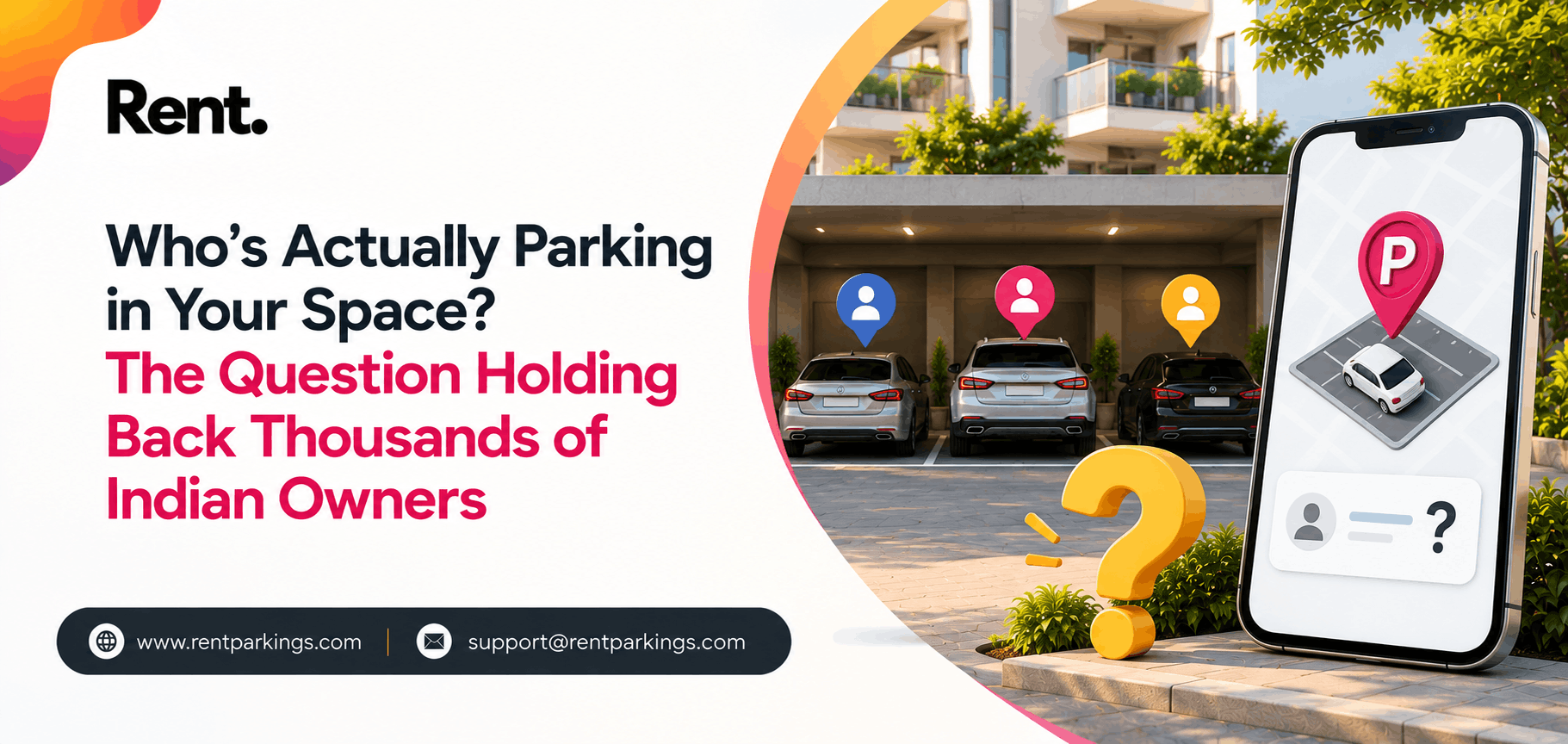
Who's Actually Parking in Your Space? The Question Holding Back Thousands of Indian Owners
Picture this. A retired schoolteacher in Coimbatore has a covered spot outside her ground-floor flat that hasn't held a vehicle in three years. Her son mentioned she could rent it out. She liked the idea for about ten minutes, right up until she thought about a stranger's car keys, a stranger's phone number, and no way of knowing who that stranger actually is.
That single worry, more than price or paperwork, is what keeps most Indian property owners from ever listing their unused parking space. Not laziness. Not distrust of the idea of extra income. Just a very reasonable question: who exactly is going to be parking there, and how would I know if something went wrong?
It's a fair question, and it deserves a fair answer rather than a sales pitch. So let's walk through what verification actually looks like when you list a spot on RentParkings, India's parking marketplace, what you can check before anyone ever touches your gate, and why this concern, once you understand the mechanics, usually turns into the reason people feel comfortable listing rather than the reason they don't.
Why This Worry Is Completely Reasonable
An empty parking spot isn't like an old cupboard you're selling on a classifieds app. It sits attached to your home, your society, sometimes your own driveway. Letting someone park there feels closer to handing over a small piece of trust than making a sale.
Owners we've spoken with describe a version of the same three fears, almost word for word:
- What if the person isn't who they claim to be, and I have no real contact details for them?
- What if their car damages something, blocks a neighbour, or simply never leaves when the booking ends?
- What if I want to say no to a booking and there's no clean way to do that without feeling rude or exposed?
None of these are irrational. They're the same questions any sensible person would ask before letting a stranger use part of their property. The difference between an owner who lists their space and one who doesn't usually comes down to whether anyone ever explained the actual safeguards in plain language.
What Verification Looks Like Before a Single Rupee Changes Hands
When someone books a spot through RentParkings, they aren't a random name typed into a form. A renter's profile carries a verified mobile number, and in most cases a government-ID check completed during signup, before they can even send a booking request to an owner.
That means by the time a request lands in your inbox, three things are already true:
- The phone number tied to the account has been confirmed as real and reachable.
- The renter's identity has passed the platform's verification step, not just an email address typed in five minutes ago.
- Their vehicle details, registration number, make, and type, are attached to the booking so you know in advance what will actually be parked in your space.
This isn't a promise that every human being on earth is trustworthy. Nothing can offer that guarantee, on any platform, in any country. What it does is remove the biggest source of anxiety for a first-time host: the idea that you're handing over access to a total unknown with zero paper trail if anything ever needs to be traced back.
If you're still at the stage of wondering what the actual mechanics of listing look like, a first-timer's walkthrough of the whole listing process lays out each step from creating a profile to publishing your first available slot, and verification fits in as just one part of that flow, not a separate hurdle.
You Get to Look Before You Say Yes
This is the part most people don't realise until they actually open the app: accepting a booking is not automatic, and it is not obligatory. As the owner, you see the renter's profile, their booking history on the platform if they have one, their vehicle information, and the exact dates and hours they're requesting, before you approve anything.
If something feels off, a booking window that seems unusually long, a vehicle type that doesn't match what your space can hold, a first-time account with no history at all, you're free to decline it and wait for the next request. There's no penalty for being selective about who parks on your property. Plenty of hosts in Chennai, Pune, and Lucknow told us they simply prefer renters with a completed profile and at least one prior booking, and they wait a few extra days for that rather than accepting the first request that comes in.
This is exactly the kind of control the earlier worry was really about. It was never about whether strangers exist. It was about whether the owner would still be the one deciding who gets in.
What Happens If Something Actually Goes Wrong
Verification reduces risk, but being realistic matters more than being reassuring for its own sake. Occasionally a renter overstays a booking, or a car gets left somewhere it shouldn't. When that happens, having a verified phone number and a booking record tied to a real identity is the difference between a five-minute phone call and a genuinely stressful evening.
Because every booking is timestamped and every renter's contact details are on file, owners have something concrete to point to if a dispute comes up, whether that's with the renter directly, with their housing society, or in a rare case with local authorities. That paper trail is quietly one of the most valuable parts of listing through a proper platform instead of just sticking a handwritten "parking available" sign on the gate and hoping for the best.
Where the Money Fits Into This Picture
It's worth saying plainly: putting your space on RentParkings costs nothing. There's no listing fee, no commission taken just to appear in search results, no hidden charge for turning on verification checks. You create a listing, add your photos and availability, and it's live.
You also decide the terms. Hourly, daily, or monthly rentals are all options, and the rate is entirely yours to set based on your locality, your competition, and how badly you actually want the extra income each month. Nobody assigns you a price. A driveway near a busy IT corridor in Bengaluru or Hyderabad can reasonably ask for more than a quiet residential lane in a smaller town, and you're the one who gets to make that call.
Once a booking is confirmed, payment moves through the app, typically UPI or net banking, rather than cash changing hands at the gate. That's not just convenient. It means there's a digital record of every transaction too, which matters if you ever need to show proof of what you earned.
Owners often ask what kind of numbers are realistic once verification and pricing are sorted. A breakdown of what hosts across different Indian cities have earned renting out an unused spot, month over month, gives a clearer sense of the range than any single figure could, since a covered spot in a dense metro pocket and one in a smaller town will rarely land on the same number.
What This Actually Looks Like Over a Few Months
Consider a fairly ordinary case: an unused covered spot in a mid-sized residential building in Kochi. The owner lists it for monthly rental first, screens two applicants using exactly the verification details described above, and settles on a working professional whose office is a ten-minute drive away.
Owners in similar situations, going by what several have described to us directly, tend to report earnings somewhere in the range of a few thousand rupees a month for a single covered spot, more in denser metro pockets, less in smaller towns, with essentially no ongoing effort once the renter is verified and the first month's terms are agreed. No inventory, no customer service line, no equipment. Just a spot that was sitting empty anyway, now generating quiet, steady income.
That's the part that tends to surprise new hosts most: how little day-to-day involvement it actually requires after the initial setup. The verification work happens up front, once, and after that it's mostly just approving or renewing bookings. Owners looking specifically at renting out spare space on the smaller, unused side of their property, rather than a large plot, often find the process described for earning money from an unused parking space maps closely onto their own situation, verification included.
A Few Practical Habits That Make Verification Work Even Better
Beyond what the platform checks automatically, a handful of habits from experienced hosts go a long way:
- Ask for a quick photo of the vehicle before the first booking begins, especially for monthly arrangements, so you have a clear record of its condition on day one.
- Keep the conversation inside the app's messaging rather than moving to personal WhatsApp immediately. It keeps a searchable record if you ever need one.
- Set clear house rules in your listing description, timing windows, whether a spare key or remote is involved, whether guests can use the spot too, so there's no ambiguity later.
- Renew or reconsider monthly renters periodically rather than assuming an arrangement is permanent. You're never locked in beyond the term you agreed to.
None of this requires technical skill or a lot of time. It's the same common sense most people already apply when they rent out a spare room or lend something valuable to an acquaintance, just applied to a parking spot instead.
Why Owners Who Clear This Hurdle Rarely Look Back
Hosts we've heard from consistently say the same thing: the first booking is the nerve-racking one. By the second or third, checking a verified profile and approving a request becomes almost as routine as checking a delivery OTP. The anxiety front-loads itself into the decision to start, and then mostly disappears.
Meanwhile, that spot near the busiest commercial and transit-heavy pockets in Indian cities that used to sit gathering dust every single day is quietly doing something useful instead. The verification piece, once it's understood, usually ends up being the last box owners needed ticked before actually publishing a listing rather than the reason they hesitated for months.
For a broader sense of the whole process from start to finish, a complete guide to renting out an empty parking space in India covers the parts this piece hasn't touched on, from photographing your spot well to writing a listing description that actually gets booking requests.
Frequently Asked Questions
1. Is listing my parking space on RentParkings really free?
Yes. There's no fee to create a listing, no charge to activate renter verification, and no cost to keep your spot visible in search results. You only deal with money when a renter actually books and pays you directly through the platform.
2. How exactly does RentParkings verify a renter before they can book my space?
Renters confirm their mobile number and complete an identity verification step during signup, and their vehicle details are attached to each booking request. You see this information before you accept anything, not after.
3. Can I reject a booking request if I'm not comfortable with the renter's profile?
Absolutely. Accepting a request is never automatic. You're free to decline any booking and wait for another one, and there's no penalty on your account for being selective about who you let park.
4. What if I only want to rent my space out for a few hours a day, not the whole month?
That's entirely your choice. You can list a spot for hourly, daily, or monthly rental, or switch between them, since the terms and pricing are set by you, not by the platform.
5. What happens if a renter's car is still there after their booking period ends?
Because every booking is tied to a verified phone number and a timestamped record, you have a direct, documented way to contact the renter and resolve it, rather than being left guessing who to even call.
6. Do I need to install any equipment, cameras, or a barrier to list my space safely?
No. Most hosts list a plain, unmodified parking spot exactly as it exists today. Verification happens on the renter's side through their profile, not through hardware you need to buy or install.
7. Will I need to meet the renter in person to hand over anything?
Not necessarily. Plenty of arrangements, especially monthly ones, are coordinated entirely through the app's messaging and a short first meeting to confirm access. It depends on your building's layout and your own preference.
8. How do I actually get paid once a booking is confirmed?
Payments move through the app using UPI or net banking rather than cash at the gate, which gives you a digital record of everything you've earned, useful if you ever need to show proof of income.
9. Is my society or building management involved in approving this?
That depends on your building's own parking rules, which vary widely across India. What RentParkings controls is the booking and verification process; your society's internal rules about who can use common parking areas are separate and worth checking beforehand.
10. What if I try listing my space and decide it isn't for me?
You can pause or remove your listing at any time. There's no contract locking you into hosting indefinitely, and no cost either way, since the entire listing process was free to begin with.
The Real Question Worth Asking
The honest version of this whole topic isn't "will something ever go wrong." Something occasionally will, on any platform, with any kind of rental. The real question is whether you'd rather deal with that as a name typed into a form with no phone number attached, or as a verified profile with a confirmed identity, a documented vehicle, and a booking record you can point to.
For most Indian property owners sitting on a spot that hasn't held a car in months, that answer becomes fairly obvious once the mechanics are actually laid out. The space was already doing nothing. Verification is what turns "doing nothing" into "earning something, safely." Start Earning from Your Parking Space by setting up a free listing today and deciding, on your own terms, exactly who gets to park there.
Share This post
Search
Recent Post
Parking Space vs. Renting Out a Room to...
05 Oct, 2026
Think Parking Rental Only Pays in Mumbai...
02 Oct, 2026
Your Mumbai Parking Space Is Worth More...
01 Oct, 2026
Hyderabad's Real Estate Boom Left One As...
30 Sep, 2026
What Your Parking Space in Chennai Could...
29 Sep, 2026
Your Plans Changed After Listing Your Pa...
28 Sep, 2026
Parking Space vs SIP: Which Idle Asset A...
25 Sep, 2026
What Your Parking Space in Pune Could Ac...
24 Sep, 2026