

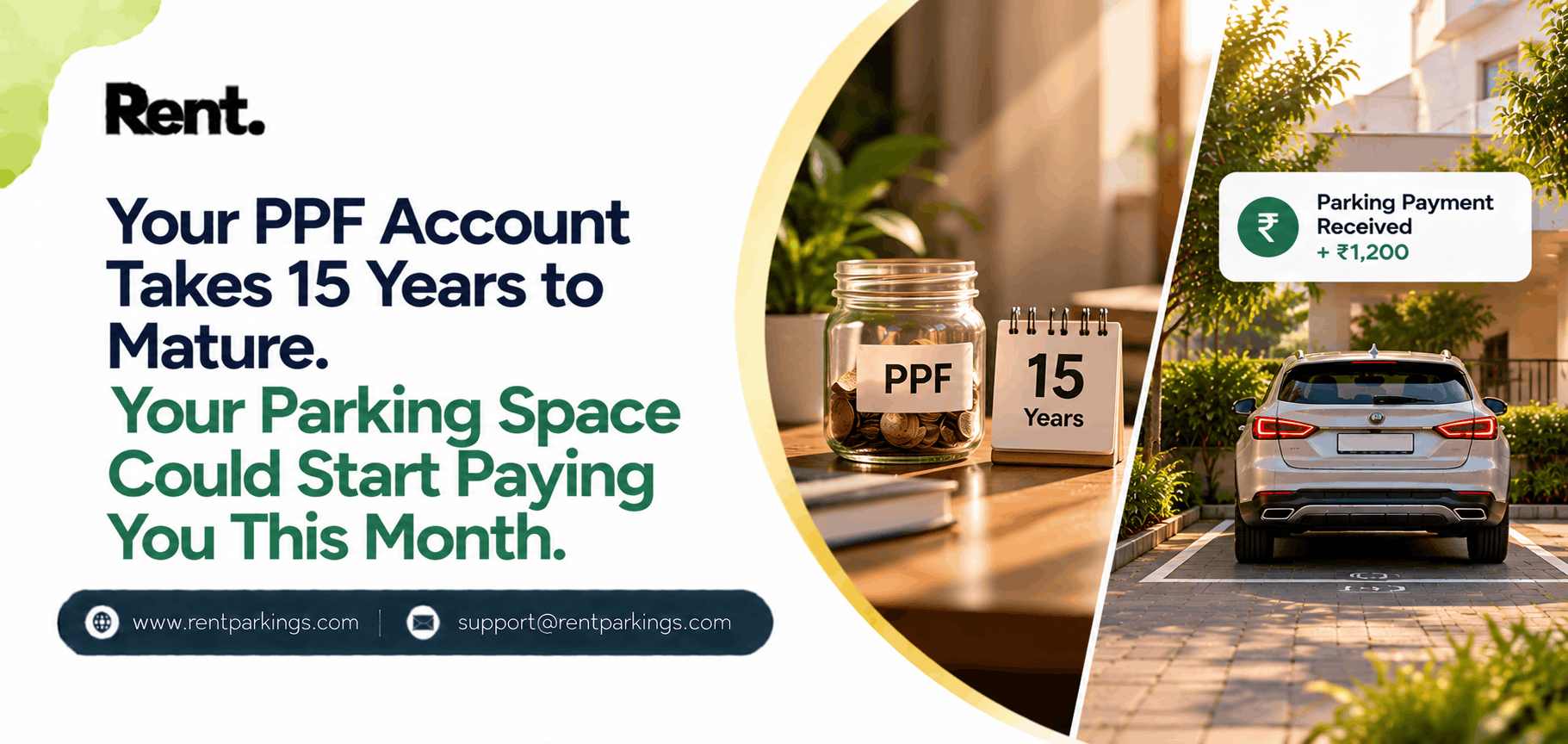
Your PPF Account Takes 15 Years to Mature. Your Parking Space Could Start Paying You This Month.
Picture a dining table in some Indian home right about now, a few weeks out from Dhanteras. Someone's quoting the day's gold rate, another person is flipping through an old PPF passbook, and between the two of them the family spends a good twenty minutes arguing over which scheme will actually carry them through retirement.
Nobody in that room ever mentions the parking slot downstairs. The one the second car used to sit in before it was sold. The one that's been collecting leaves and the occasional stray cat for the past two years.
That's the gap this piece is trying to close. Not to tell you PPF is bad, it isn't, but to point out that you may already own an asset sitting right next to your actual house that could start paying you faster, with fewer rules, and zero lock-in. You can list it for free on RentParkings in less time than it takes to fill out a PPF deposit slip.
The Diwali Money Conversation Every Indian Household Has
PPF, gold, fixed deposits, maybe a SIP if someone in the family reads finance blogs. These are the default answers whenever the topic of "where should our spare money go" comes up.
They're default answers because they're familiar, government-backed in most cases, and low-drama. Nobody has ever lost sleep over a PPF account doing something unexpected overnight.
But familiarity isn't the same as speed, and it isn't the same as flexibility either. A PPF account is excellent at one very specific job: forcing long-term discipline on money you're willing not to touch for a decade and a half. It is not designed to turn an idle asset you already own into cash flow starting next week.
PPF, Stripped Down to What It Actually Does for You
A Public Provident Fund account is a 15-year commitment. The interest rate is set by the government and reviewed every quarter, so it moves, usually within a fairly narrow band. Partial withdrawals only open up from the seventh year, and even then they come with conditions.
For a chunk of your savings, that's genuinely useful. It's one of the few places where your money grows untouched by market mood swings, and the tax treatment on maturity is a real advantage.
What it won't do is help you if you need income this quarter, this month, or honestly, this week. It's a long game, by design. The parking space you're not using isn't playing the same game at all.
Meet the Asset Already Sitting in Your Compound
Here's the part most owners skip past without noticing. A spare covered slot, an extra bay in a commercial building you own, a driveway that's only used on weekends, a vacant plot near a growing part of town: these are all assets. They just don't look like assets because nobody taught us to think of parking that way.
Unlike PPF, there's no lock-in period here. Unlike gold, there's nothing to store safely or insure against theft. Unlike a second flat, there's no tenant lease to manage for eleven months at a time. You list the space, someone books it, you get paid. The cycle can start within days of putting the listing up.
A Pairing That Makes More Sense the Longer You Sit With It
Financial planners talk about "idle asset" problems constantly: money sitting in a savings account earning next to nothing, a second car nobody drives, a flat that's locked for eight months of the year. Unused parking space is the same problem wearing a different costume.
The difference is that most of those idle-asset fixes need you to put more capital in. Parking doesn't. You already own the slot. The only thing standing between it and a monthly payout is a listing that takes a few minutes to create.
The Math: PPF Growth vs Parking Income, Side by Side
Exact numbers vary a lot by city, locality, and how in-demand the spot is, so treat the following as rough, owner-reported ranges rather than guarantees. Still, laying them side by side is useful.
- PPF contribution route: money locked for 15 years, current-cycle interest compounding annually, no cash flow until maturity or a qualifying partial withdrawal after year seven.
- A covered slot in a metro residential society: owners in busy neighbourhoods have reported monthly income somewhere in the ₹2,500 to ₹6,000 range for a single covered spot, depending on demand nearby.
- A driveway or open slot near a commercial strip, hospital, or coaching hub: several owners we've spoken with describe figures in the ₹3,000 to ₹8,000 a month band, sometimes higher during exam or festive seasons.
- A vacant plot used for short-term parking near a construction site or event venue: income here tends to be lumpier, but can spike well above the steady monthly numbers above during a busy stretch.
None of this replaces PPF, and it shouldn't. What it does is fill the gap PPF leaves wide open: income you can actually use this month, from an asset you're not paying anything extra to own.
Yes, Parking Income Isn't as Predictable as PPF. Here's the Honest Answer.
This is the honest objection, so it deserves an honest answer. PPF gives you a fixed, government-declared rate. Parking rental income depends on demand, location, and how actively a space gets booked. That's true, and it's also true of every rental-type income, whether it's a flat, a shop, or a parking bay.
The way to manage that uncertainty isn't to avoid listing, it's to set realistic expectations and keep your pricing flexible. You can list hourly, daily, or monthly, and you can change your rate any time demand shifts in your area. That control is something a PPF account will never give you.
You Don't Have to Choose One or the Other
This isn't really a competition where one asset wins and the other loses. The smarter framing is: PPF handles your long, slow-and-steady bucket. Your parking space can handle the "I need some income flowing in now" bucket, without touching your long-term savings at all.
We looked at a similar either-or question when we compared Parking Space vs Savings Account: Which Idle Asset Is Actually Working for You in 2026?, and the conclusion held there too: a savings instrument and a rental income stream aren't really competing for the same job. They're solving two different problems at once, and most households have room for both.
The same logic shows up again if you're weighing a spare room against a spare parking spot. Our piece on Parking Space vs. Renting Out a Room to a Paying Guest: Which Idle Asset Actually Pays You Better in 2026? walks through why one tends to need far less day-to-day involvement than the other, which matters if your spare time is as limited as your spare cash.
What Listing Actually Costs You: Nothing
This is the part that surprises most first-time hosts. There is no fee to create a listing on RentParkings. No subscription, no setup charge, no cut taken before you've even earned anything. You stay in control of the entire arrangement, start to finish:
- You decide the price, whether that's an hourly rate for short visits or a flat monthly rate for a long-term renter.
- You decide the hours your space is available, including blocking it off when you need it yourself.
- You decide whether to rent hourly, daily, or monthly, and you can switch between them as demand changes.
- You can pause or edit the listing whenever your plans change, no questions asked.
- Payments come to you through UPI or net banking, so there's no cash handling or awkward in-person collection.
Nobody is asking you to hand over control of your property. You're simply putting a price tag on something that was earning you exactly zero before.
Getting Started This Week
If the PPF comparison has made you curious about what your own spot could realistically bring in, the process to find out costs you nothing but a few minutes.
- Measure or estimate your space and note anything relevant, like whether it's covered, gated, or has 24-hour access.
- Take a couple of clear photos, daylight works best.
- Create your free listing and set a starting price, you can always adjust it later based on interest.
- Decide your availability window and whether you'll offer hourly, daily, or monthly bookings.
- Publish and let verified renters start reaching out.
There's no reason this has to wait for "someday." The slot is already sitting there doing nothing, after all.
It Doesn't Matter Which City You're In
This isn't a Mumbai-only or Bengaluru-only opportunity. Owners across very different markets are finding this works for them. Our breakdown of Delhi, Noida or Gurugram: Which NCR Parking Space Actually Earns You More in 2026? shows how differently three neighbouring cities in the same region can price the exact same kind of slot.
Smaller and mid-sized cities aren't left out either. A separate look at What Your Parking Space in Pune Could Actually Be Earning You in 2026 found steady demand near IT corridors and transit hubs, not just in the biggest metros.
And if you've assumed this kind of income only happens in the usual four or five big-name cities, it's worth reading Think Parking Rental Only Pays in Mumbai or Bengaluru? Jaipur, Lucknow and Kochi Owners Are Proving That Wrong, which goes into exactly why that assumption doesn't hold up anymore.
Frequently Asked Questions
Is listing my parking space on RentParkings really free?
Yes, completely. Creating a listing costs nothing, and nothing gets deducted from what you earn. The only figures you ever deal with are the price and payout terms you choose yourself.
Do I lose control over my parking space once I list it?
No. You set the price, the available hours, and the rental type (hourly, daily, or monthly). You can pause or edit the listing at any time, including blocking off dates you need the space yourself.
How does parking rental income compare to PPF in terms of risk?
PPF carries almost no risk and a fixed government rate, but your money is locked away for 15 years. Parking income fluctuates with demand but gives you cash flow immediately, with no lock-in at all.
Can I really earn more from parking than from a savings account?
For most owners, yes, a savings account typically returns a very small percentage annually, while even modest, consistent parking bookings can add up to meaningfully more over a year. Results depend heavily on your locality and demand.
What if nobody books my parking space?
Pricing and visibility both matter here. Checking what similar spots nearby are charging and adjusting your rate accordingly usually helps. You're also free to try hourly bookings first if monthly demand is slow to start.
Is it safe to let strangers park in my space?
Renters go through a verification step before a booking is confirmed, so you're not handing access to anonymous users. You also retain the final say on who you're comfortable renting to.
Do I need to pay tax on parking rental income?
Rental income is generally taxable under Indian income tax rules, the same as any other rental income would be. It's worth keeping basic records of your earnings and discussing the specifics with a tax professional for your situation.
How is this different from just letting a neighbour park for free?
An informal arrangement with a neighbour usually has nothing in writing, a vague payment schedule at best, and an awkward conversation waiting if you ever want to end it. A proper listing gives you set pricing and a documented payment trail, and you can pause or adjust it whenever your plans change.
Will I need to be available all the time to manage bookings?
No. Most of the day-to-day happens through the platform itself. Once your listing and availability are set, it runs largely on its own until you decide to change something.
What documents or paperwork do I need to start listing?
You don't need anything complicated to get a free listing live. Basic details about the space and a couple of photos are generally enough to get started, with any additional verification handled during the booking process.
The Takeaway Before Dhanteras Comes Around
PPF will still be there in fifteen years, exactly as predictable as it's always been. Your parking space doesn't have to wait that long to start contributing something. This Diwali season, instead of only moving money between the usual familiar instruments, it might be worth asking what the asset sitting right outside your door could be doing for you instead.
List Your Parking Space on RentParkings today and find out what it's actually worth. It costs nothing to list, you keep full control of your price and terms, and the income can start showing up far sooner than any 15-year scheme ever will.
Share This post
Search
Recent Post

Three People Are Circling for Parking in...
19 Oct, 2026
Rent Out Parking Without Tech Skills: An...
16 Oct, 2026
Is It Actually Legal to Rent Out the Par...
15 Oct, 2026

Jaipur's Wedding Season Isn't Just Pink...
14 Oct, 2026

Ahmedabad Has Two Very Different Parking...
12 Oct, 2026

Nobody Talks About Kolkata's Parking Mar...
09 Oct, 2026

Nobody Talks About Kolkata's Parking Mar...
08 Oct, 2026

For Three Months a Year, an Empty Drivew...
07 Oct, 2026