

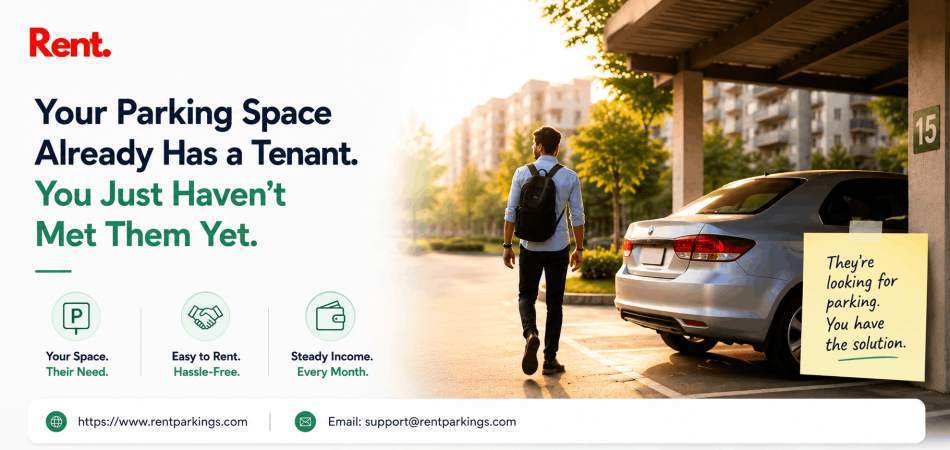
Your Parking Space Already Has a Tenant. You Just Haven't Met Them Yet.
Walk into any apartment complex in Bengaluru, Mumbai, or Delhi on a Tuesday morning and do a quiet audit.
Count the parking bays. Then count the cars.
In most buildings, the numbers do not match. Not because parking is scarce — but because a surprising chunk of allotted spaces belong to owners who travel frequently, own no vehicle, moved abroad, or simply received two slots when they only needed one. Those bays sit through rain, through summer, through festive weekends and normal weekdays — holding nothing but air.
Meanwhile, five minutes away, someone's circling the same lane for the third time, looking for a spot.
This is not a parking problem. It is a connection problem. And RentParkings.com exists to solve it — by putting the person who has the space in the same room as the person who is desperately looking for it.
If you are the person with the space, here is why listing it today is one of the sharpest financial decisions you will make this year.
The Property Asset Indians Consistently Forget They Own
Owning property in India comes with paperwork — sale deeds, possession letters, allotment certificates, and maintenance receipts. Most of it gets filed in a drawer somewhere and forgotten.
Inside that drawer, for millions of apartment owners across the country, is proof that they own a parking bay. A physical, real-world asset with a market value and a rental demand that changes by neighbourhood.
Ask any property consultant, and they will tell you that parking in metro cities has become a legitimate real estate sub-category. In South Mumbai neighbourhoods like Worli or Lower Parel, standalone parking bays trade hands for ₹10–15 lakh. In Bengaluru's Indiranagar or Koramangala, covered basement slots in high-footfall buildings are valued between ₹5–8 lakh. In Gurgaon's Golf Course Road corridor, commercial parking bays command prices that rival small studio apartments in tier-2 cities.
The rental yield from these spaces tracks the same logic. A ₹6 lakh asset earning ₹6,000 per month is delivering a 12% annual return — before accounting for the fact that you already own it and deployed nothing to acquire it.
Most FD investors would find those numbers worth a second look.
And yet most parking space owners are delivering a 0% return on that same asset — because the listing that connects them to a willing tenant does not yet exist.
What Kind of Spaces Can Be Listed — and Who Typically Lists Them
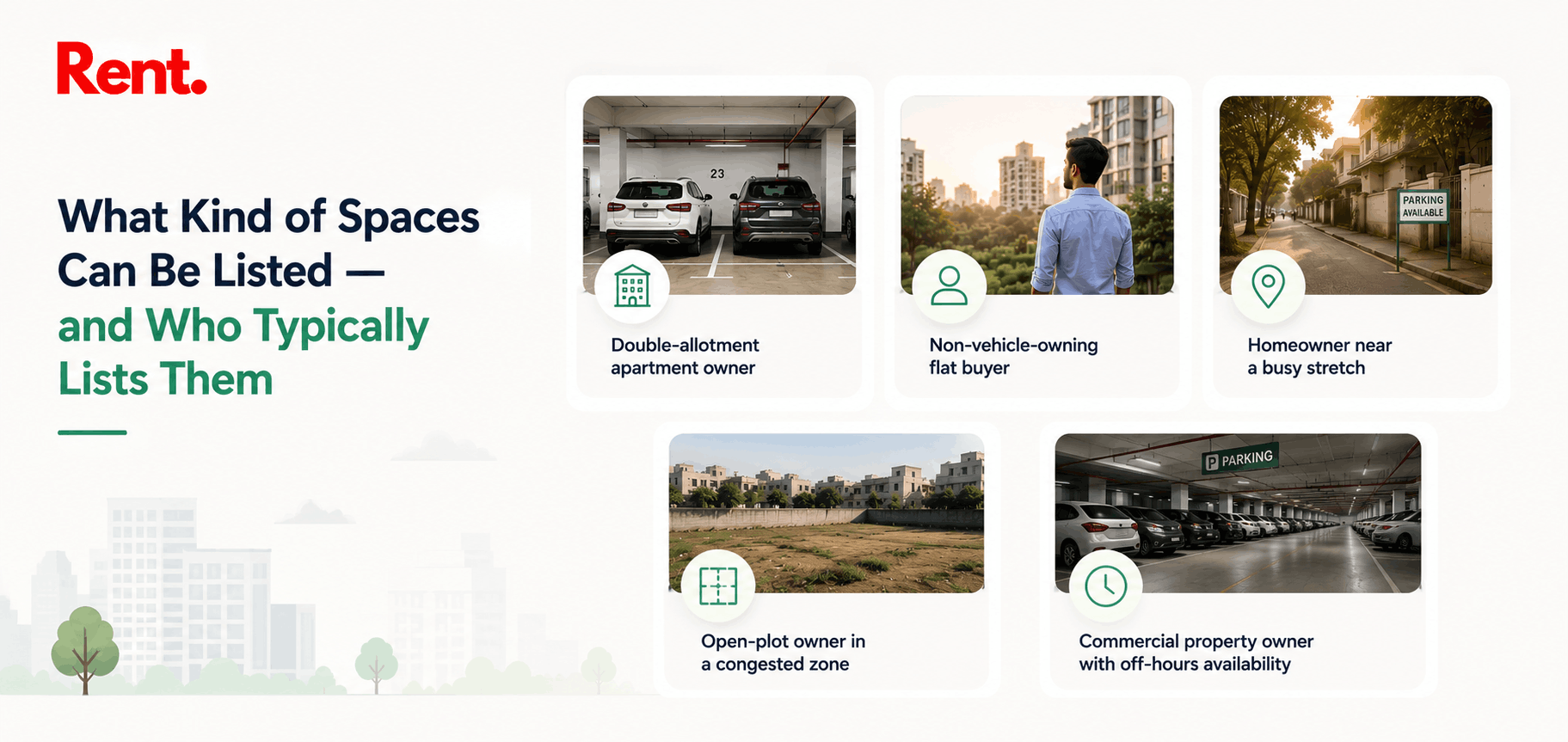
RentParkings does not work only for a specific type of property. The platform is designed for the full range of scenarios that leave parking spaces unused across Indian cities.
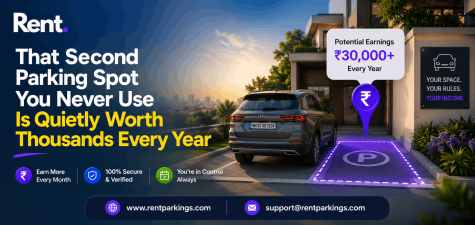
The double-allotment apartment owner. Housing societies frequently assign two parking slots to larger flat configurations — three-BHKs, penthouses, and corner units. A family with one car and two slots has a ready-made monthly earner that costs them nothing to maintain and nothing to operate. The second slot simply needs a listing.
The non-vehicle-owning flat buyer. Urban India's younger working population increasingly chooses metro, cycling, or cab-hailing over car ownership — but they still buy flats that come with parking allotments. The slot is theirs. The income from it should also be theirs. Listing takes 10 minutes and turns a document entry into a deposit.
The homeowner is near a busy stretch. An independent house near a railway station, a temple, a government hospital, or a commercial street has something that neither builders nor municipalities can manufacture: proximity. Drivers will pay a consistent monthly rate for a trustworthy spot within walking distance of where they need to be.
The open-plot owner in a congested zone. Even a modest patch of land near a market, a college campus, or a transport hub can be converted into a monthly parking arrangement with no construction, no permit, and no upfront outlay. The land does the work.
The commercial property owner with off-hours availability. Office buildings, showrooms, and clinics that operate daytime hours often have basement or surface parking that sits locked and empty from 7 PM to 8 AM. Those overnight hours represent untapped income for an asset that is already secured and maintained.
Whichever of these describes your situation, the listing process is identical — and identically short.
Honest Numbers: Here Is What Space Owners Earn in Real Indian Cities
Before you decide whether listing is worth your time, you deserve actual numbers — not vague ranges that could mean anything.
In Mumbai, the city's chronic parking deficit means even modest spaces near transport corridors earn a meaningful amount. A covered space near Andheri railway station rents for ₹7,000 to ₹12,000 per month. Dadar and Borivali corridors sit at ₹6,000 to ₹10,000. Open spaces slightly further from stations still command ₹4,000 to ₹7,000, depending on the lane and the demand cluster.
In Bengaluru, Whitefield and ITPL proximity drives strong demand — covered spaces near the tech belt earn ₹4,500 to ₹8,000 monthly. Koramangala and Indiranagar listings near restaurant or co-working clusters see ₹5,000 to ₹9,000. Sarjapur Road and Electronic City, despite being further out, see stable ₹3,000 to ₹6,000 monthly from IT campus employees who cannot access company parking.
In Delhi NCR, metro corridor adjacency is the dominant price driver. Covered slots near Noida Sector 18, Cyber City in Gurgaon, or South Extension in Delhi earn ₹5,000 to ₹13,000 per month. Hospital-adjacent spaces near AIIMS or Safdarjung earn ₹4,000 to ₹8,000 from medical professionals and patients' families on extended stays.
In Pune, Hinjewadi and Baner see ₹3,500 to ₹7,000 monthly for covered parking from IT professionals. Viman Nagar and Kalyani Nagar near the airport and office clusters sit at ₹3,000 to ₹6,500.
In Hyderabad, HITEC City and Kondapur covered bays earn ₹3,500 to ₹7,500 monthly. Banjara Hills and Jubilee Hills command slightly more due to premium demand.
For tier-2 cities — Jaipur's Vaishali Nagar, Lucknow's Hazratganj, Coimbatore's RS Puram, Nagpur's Dharampeth — spaces near railway stations or major hospitals consistently earn ₹1,500 to ₹4,000 per month. Smaller absolute numbers, but with almost no listing competition and highly loyal monthly tenants.
Annual earnings from a single well-located covered space in a metro city sit between ₹54,000 and ₹1.5 lakh. That is from one space. That is from something you already own.
The 10-Minute Listing — What Actually Happens When You Sign Up
People often assume there is a complicated onboarding process. There is not. Here is what the experience looks like.
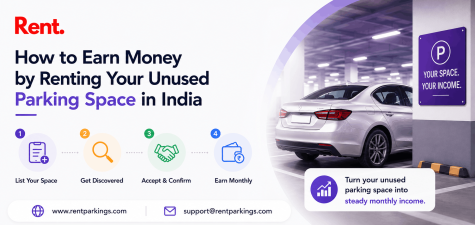
You open RentParkings.com on your phone or laptop. You create a free account. You begin your listing by entering your property's location — the area name and the nearest landmark that someone in a car would recognise, like a metro station exit, hospital gate, or tech park name.
Then you add the space details — open, covered, or basement; car, bike, or both; the access timings; and whether you prefer hourly, daily, or monthly bookings. Monthly is the most popular option and the lowest-maintenance for first-time listers.
You upload your photographs — two is enough, three is ideal. One showing how a driver approaches the space, one showing the space itself from inside. This step takes two minutes with a phone camera.
You set your monthly price based on what similar listings nearby are charging. The platform shows you active listings in your area, so you are not guessing.
You publish.
From that point, your listing is live and searchable. Verified seekers browsing for parking near your location will find it, message you, and — once you confirm the arrangement — become your monthly tenant. You receive the agreed amount digitally each month.
No broker is taking a cut. There is no complicated legal process for a standard monthly arrangement. And once the tenant is in place, your daily involvement is zero.
Three Concerns Most Listers Have — Answered Plainly
"What if my housing society does not allow it?"
This question comes up often, and the answer is more reassuring than most people expect. The majority of housing societies in India treat parking allotments the same way they treat flats — as the private property of the allottee, subject to reasonable sub-leasing. What some societies ask for is a notification to the committee before a new tenant begins. A brief message to your RWA secretary or a note in the resident group is typically all that is needed. Very few societies have an outright prohibition, and even fewer enforce it actively.
"What happens if the tenant stops paying or causes a problem?"
Monthly arrangements on RentParkings operate on a month-to-month basis. If a tenant defaults or causes a concern, the arrangement simply does not renew. You are not locked into a year-long lease with enforcement complications. The low-friction nature of parking rentals — a concrete bay with no fixtures, no maintenance, no shared utilities — means that disputes are rare and easy to resolve when they do arise.
"I am worried I will have to be available all the time."
This is the concern that most consistently turns out to be unfounded once listers have their first tenant. A monthly arrangement means your tenant has fixed, assigned access to your specific bay. They do not need you at arrival, at departure, or at any point during the month. The most common experience new listers describe is realising they forgot they had listed — until the month's rent notification arrived.
Frequently Asked Questions About Listing Your Parking Space
How do I decide what monthly price to charge for my parking space?
Start by looking at what comparable spaces in your area are listed for on RentParkings. Factor in whether your space is covered or open — covered bays consistently command 30 to 50 per cent more — and how close you are to a high-demand landmark like a metro station, hospital, or tech park. Begin at the mid-range for your city and adjust after your first month based on inquiry volume. A strong location can support a higher rate than you might initially expect.
Can I list my parking space if I am currently renting my apartment and not the owner?
In most cases, only the parking space owner — the person named in the allotment document — can sub-lease it. Tenants occupying a flat do not automatically inherit the right to sublet the parking bay unless the flat owner explicitly permits it in writing. If you own the flat and the parking allotment, you are free to list regardless of whether you live there yourself.
What documents do I need to list my parking space on RentParkings?
No documents are required to create a listing. You simply need the location details, photographs of the space, and your preferred pricing. A written rental agreement between you and your tenant is advisable for monthly arrangements — it does not need to be legally registered for standard terms and gives both parties a clear reference point.
Is there a best time of year to list a parking space in India?
Listings that go live between January and March, and between July and September, tend to attract tenants faster — these align with job-change cycles and the start of academic semesters, when a large number of people relocate within cities and urgently need nearby parking. That said, demand in major Indian metros runs consistently year-round. A well-priced listing in a strong location will find a tenant in any month.
What if I want to use the space myself again after renting it out?
Month-to-month arrangements give you full flexibility. At the end of any month, you can choose not to renew and reclaim the space for personal use. Most listers simply give their tenant a week's advance notice as a courtesy — something most tenants appreciate and reciprocate with a smooth handover. There is no penalty and no complication involved.
One Last Thing Before You Close This Tab
You have read this far, which probably means one of two things: you have a parking space that you know is sitting unused, or someone forwarded you this page because they noticed yours.
Either way, the situation is the same. An asset you own — something with a real market value in a city where parking demand is measurably outpacing supply — is currently earning nothing. Not because there is no demand for it. Not because listing it is complicated. Simply because the listing does not yet exist.
It takes ten minutes to create one.
List your parking space on RentParkings — free to list, start earning this week →
Share This post
Search
Recent Post
How to Earn Money by Renting Your Unused...
03 Jun, 2026
Your Parking Space Is Silently Burning M...
02 Jun, 2026
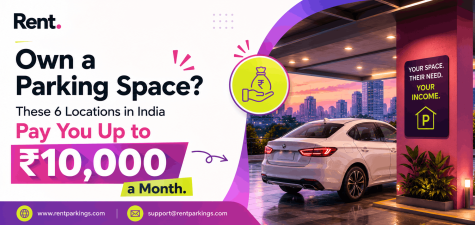
Own a Parking Space? These 6 Locations i...
01 Jun, 2026
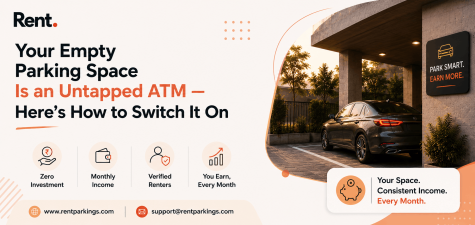
Your Empty Parking Space Is an Untapped...
29 May, 2026
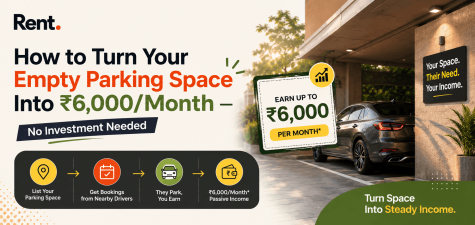
How to Turn Your Empty Parking Space Int...
28 May, 2026
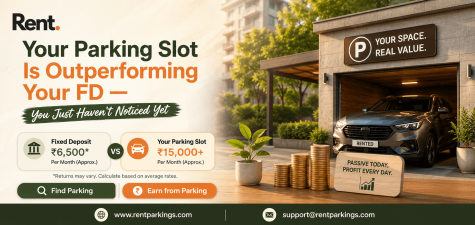
Your Parking Slot Is Outperforming Your...
27 May, 2026
That Second Parking Spot You Never Use I...
26 May, 2026
How to Earn Money by Renting Your Unused...
23 May, 2026